From ordering groceries to ordering medicines, everything has become digital now (and that to be too easily!). But, who knew that ordering liquor beverages straight away to your home could be normalized? Well, this particular addition to the e-commerce industry shook the active users of online delivery platforms (literally!).
The buzz for the online app for delivering alcohol is at an all-time high, isn’t it? But, it gained more popularity when big food delivery giants like Swiggy and Zomato came into the picture. Well, this is just the beginning because “Picture abhi baaki hai mere dost!!”
Let us tell you the fact that it’s not just India where this craze can be seen, apparently on-demand liquor ordering apps are transforming the market worldwide. Now, long gone are the days of standing in line to grab a few bottles of your favorite drinks. Yes, that’s true because technology is reshaping every industry, and liquor delivery is no different.
By partnering with an alcohol delivery app development company, you can create an app that lets customers order liquor straight from their phones and have it delivered to their doorstep. Sounds easy-peasy, right?
How did the app for liquor delivery gain sudden popularity?

In today's highly digitally-dependent world, mobile phones are essential for almost everything, including shopping. So, online ordering has become the go-to method for buying anything, including alcohol. According to a recent report, the global on-demand alcohol e-commerce delivery market is expected to grow to $120.61 billion by 2028 at a CAGR of 16.4%.
So, if you're thinking about starting a liquor delivery business, you're in the right place. This guide will take you through the key steps to building a successful alcohol delivery app, helping you stand out in a competitive market and meet the growing demand for convenient, on-demand services.
5 easy Steps to Online liquor delivery app development
Creating an online liquor delivery app can be an exciting journey, and following a clear plan will help you succeed. Here are five key steps to guide you.
Step 1: Plan Your Strategy
Start by building a solid strategy that covers everything from your initial investment and key value propositions to costs, revenue streams, and networks. A detailed business plan will make it easier to execute your ideas. Make sure to secure funding early on to avoid any interruptions once you start.
Step 2: Find the Right Developers
Even though this app might be your dream project, you'll need technical experts to bring it to life. Partner with a trustworthy team of developers, and be clear about your expectations and ideas from the start. This helps avoid misunderstandings and keeps the project on track.
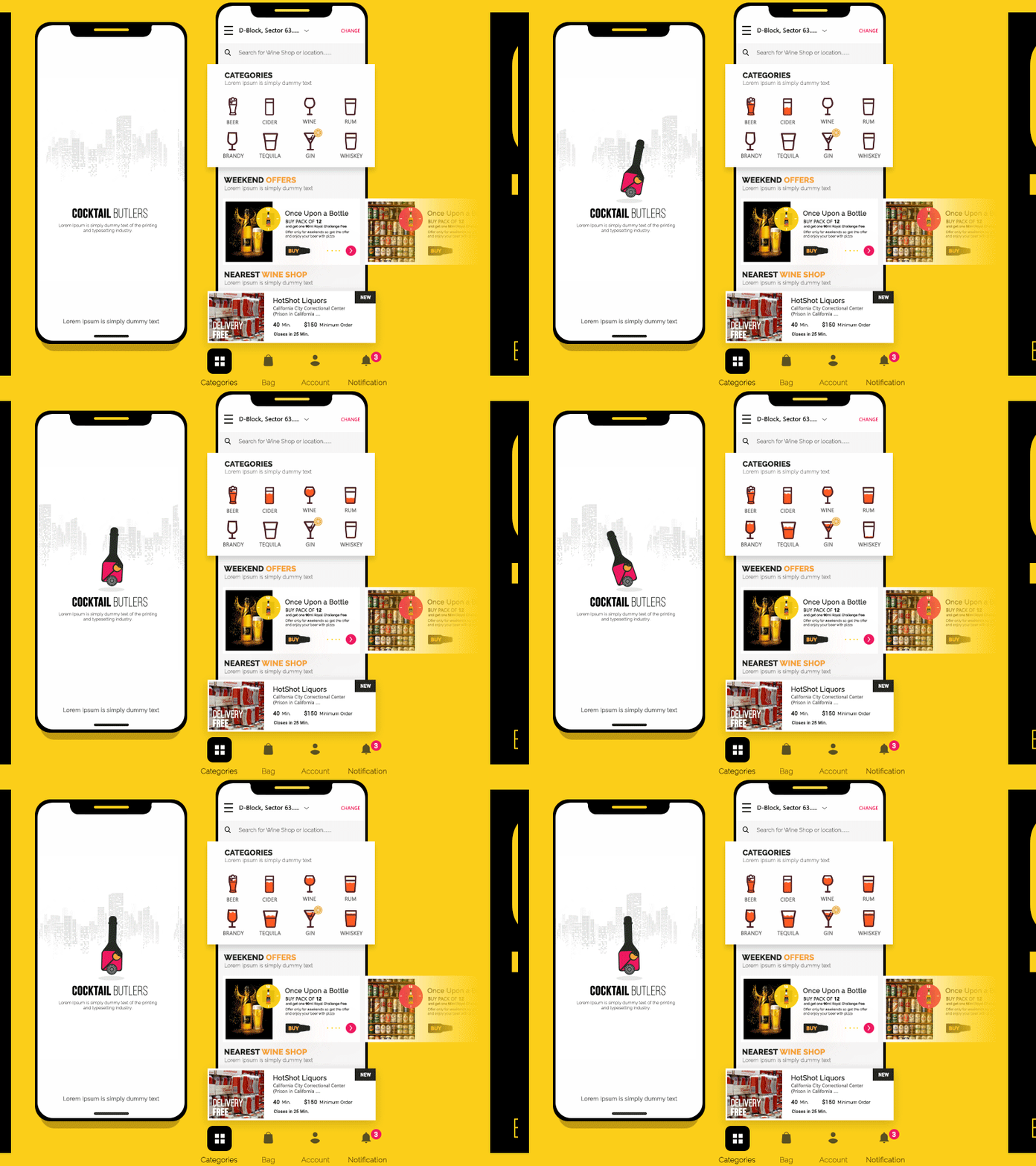
Step 3: Create a User-Friendly Interface
Focus on designing a user interface that’s easy and enjoyable to use before you start building the database. Work closely with engineers, designers, and your brand manager to ensure the user experience is smooth and intuitive, as this is what your customers will interact with the most.
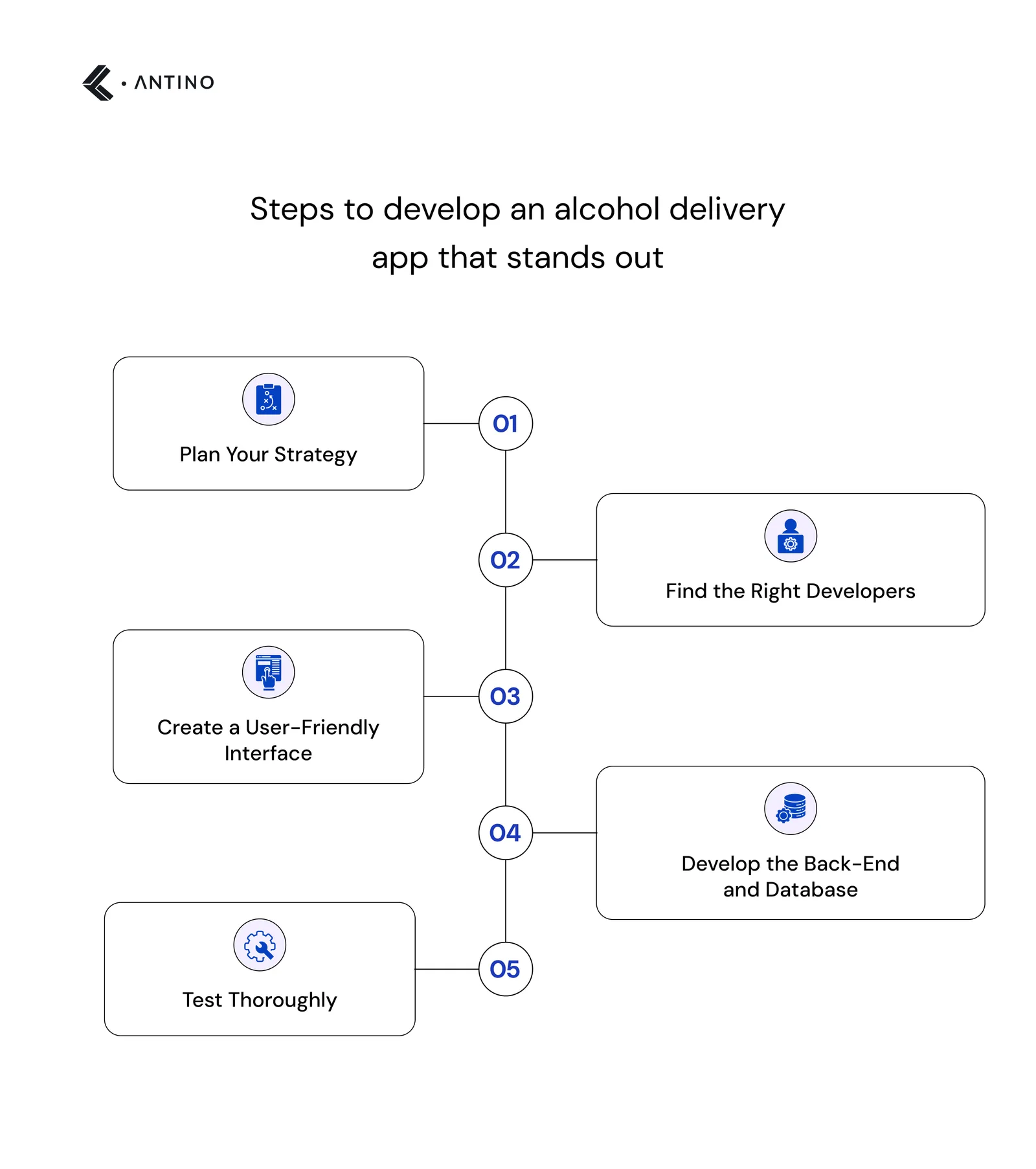
Step 4: Develop the Back-End and Database
Once the user interface is ready, start working on the back-end and database. Begin with a small dataset to create a minimally viable product (MVP). This allows you to test the basic functions and make any necessary changes before the full launch.
Step 5: Test Thoroughly
After the app is built, it’s time for rigorous testing. Your development team should conduct thorough tests to find and fix any bugs. Once everything is working smoothly, you can launch the app and start delivering to your customers.
By following these steps, you'll be well on your way to creating a successful online liquor delivery app. But, now the question is, how much will it cost? Let’s go through that in detail.
Cost to develop a liquor ordering app
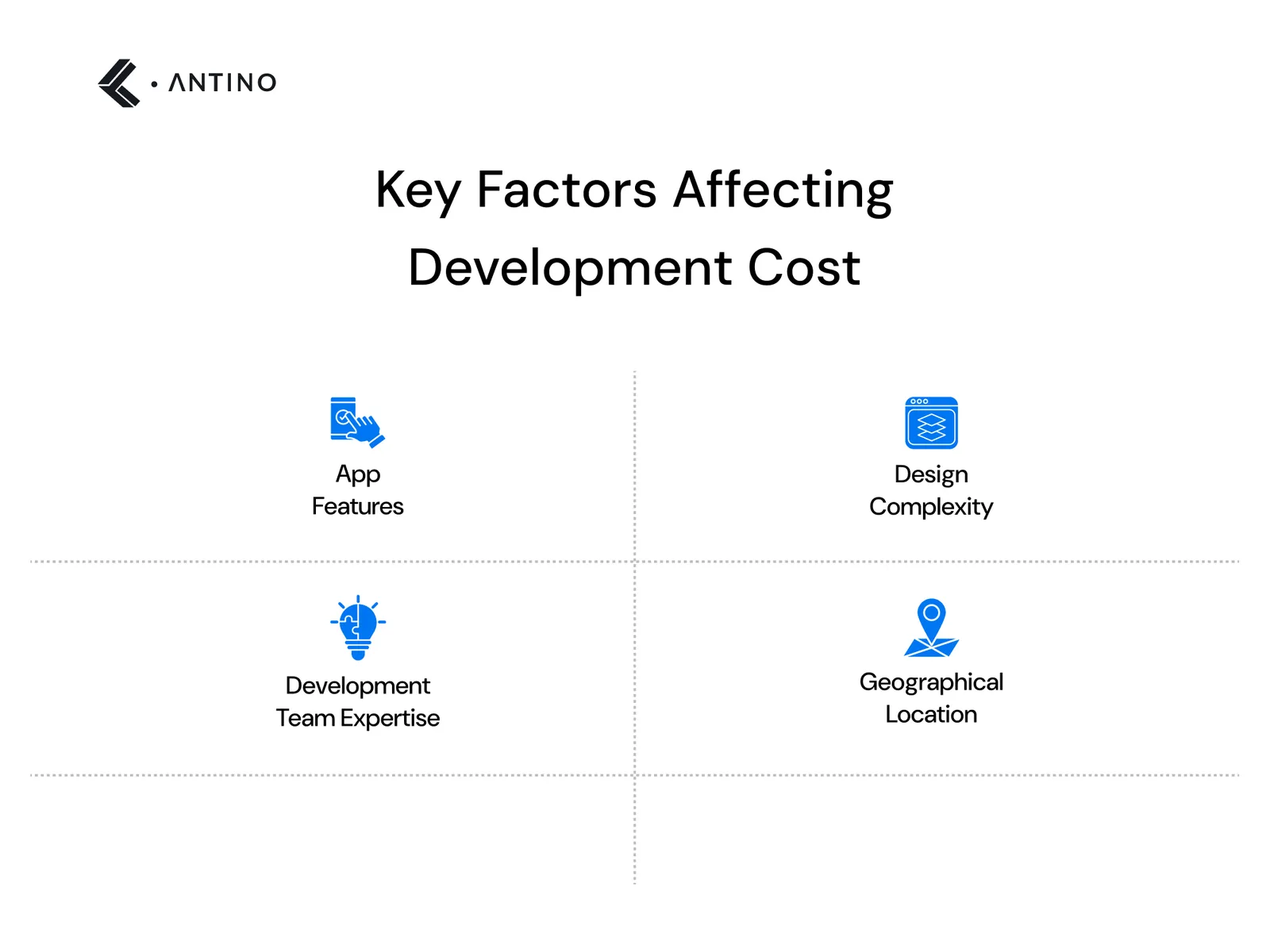
Creating a liquor delivery app is an exciting venture, but it's important to know what you're getting into, especially when it comes to costs. The overall expense will depend on several factors, including the features you want, the design complexity, and the development team's location and expertise. and the development team's location and expertise. Additionally, understanding the types of bars that will use your app—whether they're casual lounges, upscale cocktail bars, or sports bars—can influence the app's design and functionality. Here's a straightforward breakdown to give you a clearer picture.
Key Factors that affects alcohol delivery app development
Several factors affect the development of an app for liquor delivery. So, let’s read about them in detail.
1. App Features
Basic: Features like user registration, product search, shopping cart, payment gateway, order tracking, and simple notifications.
Advanced: Add user profiles, detailed product descriptions, advanced search filters, reviews and ratings, loyalty programs, and more sophisticated notifications.
Complex: Real-time inventory management, AI recommendations, multiple payment options, social media integration, analytics dashboard, and personalized offers.
2. Design Complexity
Basic Design: Straightforward UI/UX with standard elements.
Advanced Design: Custom UI/UX with interactive elements and some animations.
Complex Design: High-end UI/UX with advanced animations, transitions, and a fully branded experience.
3. Development Team Expertise
Costs vary based on whether you hire freelancers, a mid-level agency, or a top-tier app development company.
4. Geographical Location
App Development costs can vary widely based on where your developers are located. For instance, developers in North America and Europe generally charge more than those in Asia or Eastern Europe.
Here’s The Features Comparison Chart
| Feature/Design Complexity | Basic App | Advanced App | Complex App |
| User Registration | ✔ | ✔ | ✔ |
| Payment Gateway | ✔ | ✔ | ✔ |
| Order Tracking | ✔ | ✔ | ✔ |
| User Profiles | ✖ | ✔ | ✔ |
| Detailed Descriptions | ✖ | ✔ | ✔ |
| Advanced Search Filters | ✖ | ✔ | ✔ |
| Reviews & Ratings | ✖ | ✔ | ✔ |
| Loyalty Programs | ✖ | ✔ | ✔ |
| Advanced Notifications | ✖ | ✔ | ✔ |
| Real-time Inventory | ✖ | ✖ | ✔ |
| AI Recommendations | ✖ | ✖ | ✔ |
| Multiple Payment Options | ✖ | ✖ | ✔ |
| Social Media Integrations | ✖ | ✖ | ✔ |
| Personalized Offers | ✖ | ✖ | ✔ |
Detailed cost breakdown of building a Liquor app
We know that you’re curious to know about the exact cost of building an alcohol delivery. So, without further ado, let’s read ahead.
Basic Liquor Ordering App
- Features: User registration, product search, shopping cart, payment gateway, order tracking, and basic notifications.
- Design: Simple UI/UX.
- Estimated Cost: $30,000 - $50,000
- Development Time: 3-6 months
Advanced Liquor Ordering App
- Features: User profiles, detailed product descriptions, advanced search filters, reviews and ratings, loyalty programs, and advanced notifications.
- Design: Custom UI/UX with interactive elements.
- Estimated Cost: $50,000 - $100,000
- Development Time: 6-9 months
Complex Liquor Ordering App
- Features: Real-time inventory management, AI-based recommendations, multiple payment options, social media integration, analytics dashboard, and personalized offers.
- Design: High-end UI/UX with sophisticated animations and a fully branded experience.
- Estimated Cost: $100,000 - $200,000+
- Development Time: 9-12+ months
Cost Comparison Chart
| Design | Simple | Custom | High-end |
| Estimated Cost | $30,000 - $50,000 | $50,000 - $100,000 | $100,000 - $200,000+ |
| Development Time | 3-6 months | 6-9 months | 9-12+ months |
Developing a liquor ordering app can range from $30,000 for a basic app to over $200,000 for a complex one. By understanding your specific needs and budget, you can choose the right level of complexity for your app. This way, you’ll be better prepared to turn your app idea into a reality.
What are some of the legal regulations that need to be considered while launching any alcohol delivery app?
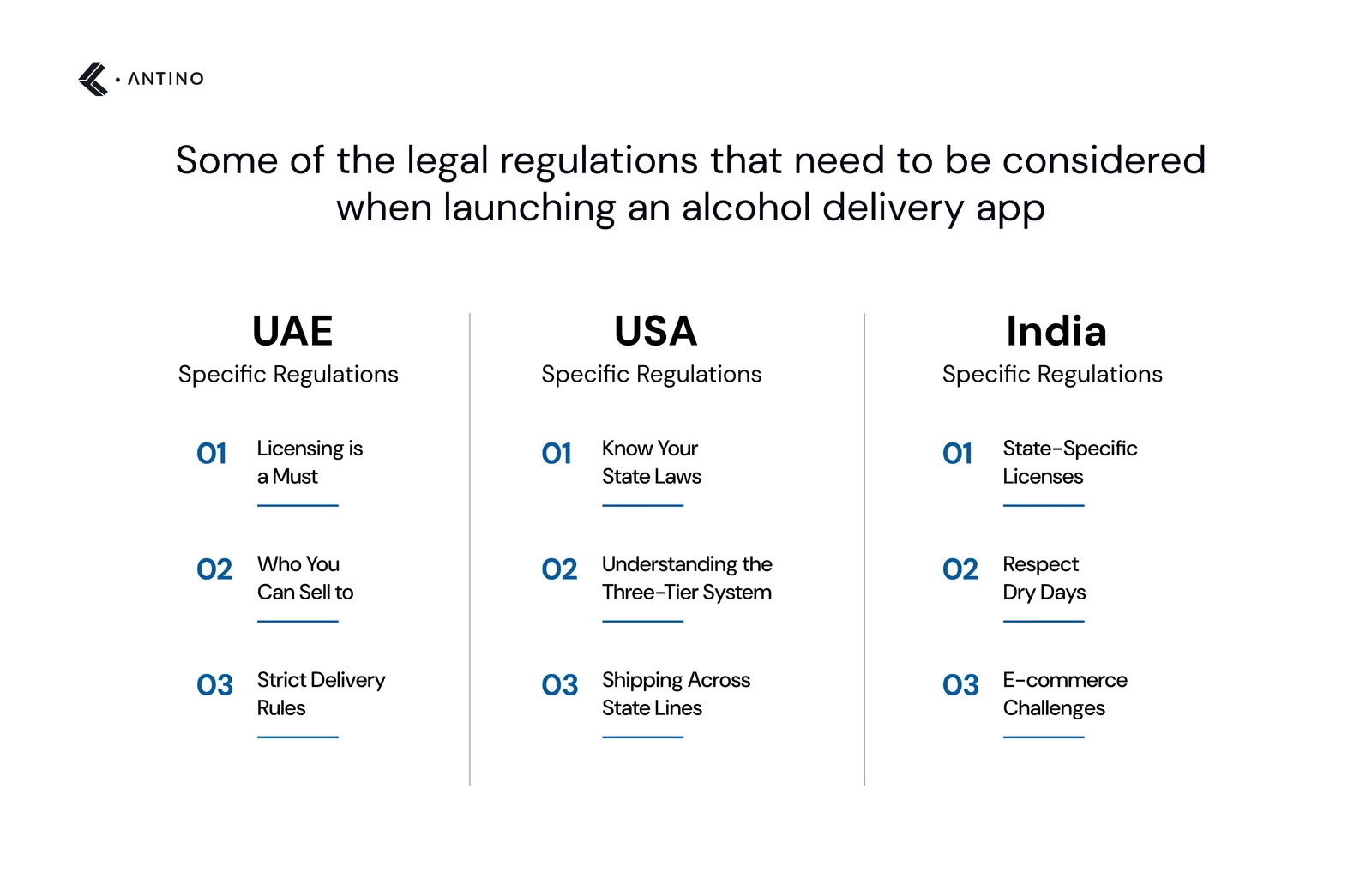
When launching an alcohol delivery app, you need to navigate a web of legal regulations that vary greatly depending on where you are. Here's a breakdown of what you need to know if you're planning to operate in the UAE, USA, or India.
UAE-Specific Regulations
In the UAE, alcohol laws are particularly strict because of cultural and religious factors.
- Licensing is a Must: Only certain businesses can sell alcohol, and they need to have specific licenses from local authorities like the Department of Economic Development.
- Who You Can Sell To: Alcohol can only be sold to non-Muslim residents who have a liquor license, and it has to be delivered directly to their homes. Public drinking and alcohol promotions are highly restricted.
- Strict Delivery Rules: There are tight controls over when alcohol can be delivered, and delivery personnel need to follow strict guidelines to ensure everything is done by the book.
USA-Specific Regulations
In the USA, alcohol laws are all over the place because each state has its own rules.
- Know Your State Laws: Every state has its own rules for selling and delivering alcohol. Some states allow direct-to-consumer shipments, while others are much stricter.
- Understanding the Three-Tier System: The US has a three-tier system where alcohol has to go from the producer to a distributor before it can reach retailers. You’ll need to navigate this system to stay compliant.
- Shipping Across State Lines: If you plan to deliver alcohol across state borders, you’ll need to follow federal regulations, making sure you adhere to the laws in both the sending and receiving states.
India-Specific Regulations
In India, alcohol laws differ from state to state, making things even more complicated.
- State-Specific Licenses: Each state has its own set of licenses for selling and delivering alcohol. Some states, like Gujarat, have banned alcohol altogether, while others like Goa have more relaxed rules.
- Respect Dry Days: Certain days are “dry days” when alcohol sales are banned, like national holidays or religious events. Your app needs to be aware of these and avoid operating on those days in states that enforce them.
- E-commerce Challenges: Some Indian states don’t allow alcohol sales online at all, so you’ll need to know the rules in each state before offering your services.
Starting an alcohol delivery app isn’t just about having a great idea and a smooth user interface. You’ve got to dive deep into the legal landscape of the places you want to operate in. The rules in the UAE, USA, and India are all very different, so make sure you’re tailoring your operations to meet each region’s specific legal requirements. This means getting the right licenses, setting up strong age checks, following delivery rules, and being careful with your marketing. Getting this wrong can lead to serious consequences, so it’s worth the effort to get it right from the start.
How does even the revenue model work in liquor ordering apps?
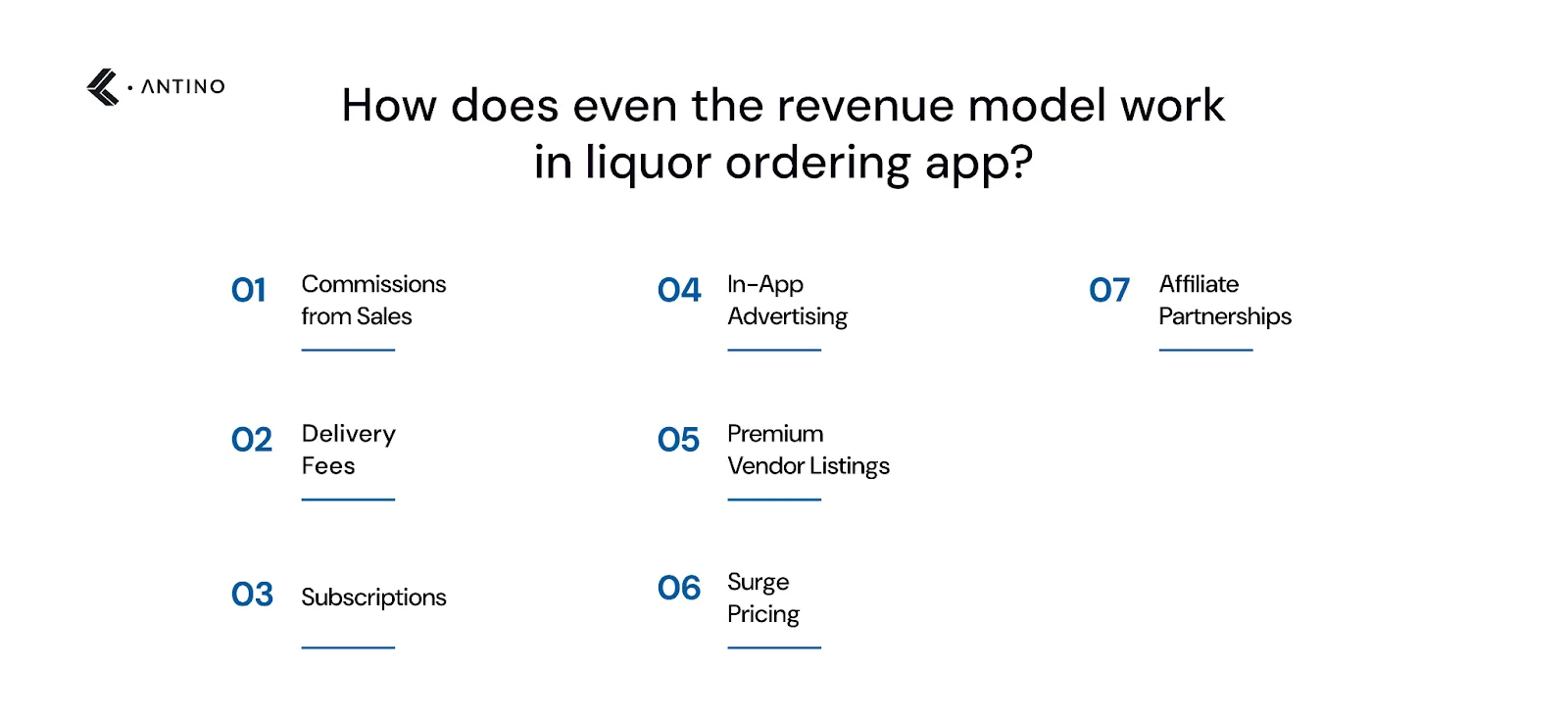
Creating a revenue model for a liquor delivery app involves figuring out how to make money while keeping users and partners happy. Here's a look at how it typically works:
1. Commissions from Sales
One of the main ways these apps make money is by taking a commission on each sale. The app partners with local liquor stores, bars, or wholesalers, and for every order placed through the app, it earns a percentage of the sale- usually between 10% and 30%.
2. Delivery Fees
Another big revenue stream is the delivery fee. This fee can be a flat rate or vary based on factors like how far the delivery is, how quickly the customer wants it, or how big the order is. Some apps offer free delivery if the order is above a certain amount, which encourages customers to buy more while still covering costs through commissions.
3. Subscriptions
Some apps offer a subscription service where customers pay a monthly or yearly fee in exchange for perks like free delivery, faster service, or access to exclusive deals. This not only brings in steady income but also helps build customer loyalty.
4. In-App Advertising
Liquor brands and local vendors can pay to advertise their products within the app. This might mean getting their products featured more prominently or running targeted ads based on user preferences. Offering advertising space adds another layer of revenue without increasing the cost for users.
5. Premium Vendor Listings
Vendors can pay extra to have their store or products appear at the top of search results or be featured in special promotions. This helps them attract more customers while giving the app an additional revenue source.
6. Surge Pricing
Similar to ride-sharing apps, some liquor delivery apps increase prices during peak times like holidays or weekends. This "surge pricing" means higher delivery fees or product prices when demand is high, helping the app earn more during busy periods.
7. Affiliate Partnerships
The app can team up with other businesses, like event planners or food delivery services, to cross-promote each other's services. By doing this, the app can earn a commission on any sales that come through these partnerships.
A liquor delivery app can make money in several ways- through commissions, delivery fees, subscriptions, ads, and more. By mixing these revenue streams, the app can create a solid business model that not only generates income but also keeps users and vendors satisfied.
Why should partner with Antino as your alcohol delivery app development company?
When you're ready to turn your idea for an alcohol delivery app into reality, Antino is here to help you every step of the way. We’re all about creating apps that are not just easy to use but also safe and reliable. Whether it’s making sure your customers can quickly find what they’re looking for, adding secure payment options, or ensuring age verification is a breeze, we’ve got you covered.
We understand that every detail matters, and we’ll work closely with you to build an app that stands out and makes your customers’ experience smooth and enjoyable. Let’s team up and bring your app to life together.
Key Takeaways
1. The demand for alcohol delivery apps is growing rapidly, especially with big players like Swiggy and Zomato entering the market.
2. This trend isn’t limited to India, but on-demand alcohol delivery apps are transforming markets worldwide, making liquor delivery more convenient.
3. Steps to Develop an Alcohol Delivery App:
- Plan Your Strategy
- Find the Right Developers
- Create a User-Friendly Interface
- Develop the Back-End and Database
- Test Thoroughly
4. The cost of developing an alcohol delivery app can range from $30,000 to over $200,000, depending on features, design complexity, and development team location.
5. Launching an alcohol delivery app requires navigating complex legal regulations, which vary significantly across regions like the UAE, USA, and India.
6. Revenue Models:
- Commissions
- Delivery Fees
- Subscriptions
- In-App Advertising
- Premium Vendor Listings
- Surge Pricing
- Affiliate Partnerships
- Data Selling